The Mid-Atlantic Fishery Management Council met by webinar February 10-11, 2026. The following is a summary of actions taken and issues considered during the meeting. Presentations, briefing materials, motions, and webinar recordings are available on the Council’s February 2026 meeting page.
PDF Version: February 2026 Council Meeting Summary
Highlights
During this meeting, the Council:
Received an update on revisions to the Marine Recreational Information Program Fishing Effort Survey*
Provided feedback on plans for the Recreational Sector Separation Amendment Workshop and agreed to hold the workshop in September 2026*
Agreed to postpone further development of a white paper on recreational data collection and use*
Received an update on development of new models and methods to help fishermen predict and avoid river herring bycatch
Directed staff to solicit input from its Scientific and Statistical Committee on the biological linkages between the current U.S. catch limits and the Northwest Atlantic Fisheries Organization quota
Received an update on the New England Fishery Management Council’s risk policy and strategic planning work
Appointed Dr. Ming Sun and Dr. Jennifer Bigman to the Scientific and Statistical Committee
Discussed a risk/value matrix developed by NOAA Fisheries to inform prioritization of fisheries management and science activities nationwide
Reviewed a summary of public comments received by NOAA Fisheries on Executive Order 14276 and concluded that no revisions to the Council’s previous recommendations are needed
* Items denoted with an asterisk (*) were undertaken during joint meetings with the Atlantic States Marine Fisheries Commission’s Interstate Fisheries Management Program Policy Board
Recreational Fisheries Issues
The Council met jointly with the Atlantic States Marine Fisheries Commission’s Interstate Fisheries Management Program Policy Board (Policy Board) to receive updates on several recreational fisheries related issues.
Marine Recreational Information Program Fishing Effort Survey
Dr. Katherine Papacostas, Branch Director for NOAA Fisheries Recreational Statistics, provided an update on revisions to the Marine Recreational Information Program (MRIP) Fishing Effort Survey (FES). The FES is a mail-based survey that collects data on recreational saltwater fishing activity, specifically measuring the number of fishing trips taken by anglers in private boats or from shore.
Following a 2023 pilot study that identified potential sources of bias in the FES, a large-scale evaluation of survey design was conducted in 2024. Peer reviews of the revised methodology and associated recalibration approaches were conducted in 2025 and are currently under internal review at NOAA Fisheries. Calibrated catch estimates are expected to be released in summer 2026. Delivery of these estimates was delayed by the fall 2025 government shutdown. Additional information and updates are available here.
Recreational Sector Separation Amendment Workshop Plans
The Council and Policy Board provided feedback on plans for a stakeholder workshop to seek input on draft alternatives for the Recreational Sector Separation Amendment. The amendment considers separate management strategies for the for-hire and private angler modes, as well as for-hire permitting and reporting requirements for summer flounder, scup, black sea bass, and bluefish.
The workshop was first proposed in December 2025 after the groups reviewed draft alternatives and determined that additional stakeholder input was needed to develop the management options. At the February meeting, the Council and Policy Board agreed to hold the workshop in September 2026. While originally planned for spring or summer, that timing was expected to pose major challenges for recreational stakeholder participation.
The workshop will convene a small group of for-hire and private recreational stakeholders to provide input on, and help refine, the range of draft options. Discussions will focus primarily on the existing draft options; however, the Council and Policy Board also directed the Fishery Management Action Team and Plan Development Team (FMAT/PDT) to develop a variation on the draft alternative for regional for-hire management measures for discussion as part of the workshop. This “for-hire baseline measures” option would create a process for setting regional measures tailored specifically to the needs of the for-hire mode. Private/shore measures would then be developed after evaluating expected for-hire catch, to ensure the overall harvest target is not exceeded.
The groups also reviewed a revised amendment timeline, with final action tentatively scheduled for August 2027. This timeline may be adjusted based on feedback received at the workshop and subsequent direction from the Council and Policy Board.
Recreational Data Collection and Use White Paper Outline
The Council and Policy Board reviewed a draft outline for a white paper on improving recreational data collection and use in the summer flounder, scup, black sea bass, and bluefish fisheries. This issue was originally included in the Recreational Sector Separation Amendment; however, in April 2025, the groups agreed to address it separately through a white paper. Council staff developed the draft outline as an initial step, with full development planned for the rest of 2026.
At the February meeting, Council staff requested feedback on the outline and recommended postponing further development of the white paper. Staff noted potential overlap with the ongoing Recreational Sector Separation Amendment – particularly the draft alternatives related to modifying for-hire permitting and reporting requirements at the state and/or federal levels – as well as anticipated revisions to the MRIP FES. The revised FES methodology will result in re-calibrated MRIP estimates, which may need to be accounted for in the white paper.
Without objection, the groups agreed to postpone further development of the white paper, citing uncertainty about when calibrated MRIP estimates will be released. The project will be revisited once calibrated MRIP estimates become available.
River Herring Bycatch Risk Prediction Project
Researchers from the University of North Carolina presented Species Distribution Models (SDMs) that forecast where river herring, Atlantic herring, and Atlantic mackerel are likely to be found—one week into the future. Three forecasts are currently being provided to fishermen:
Areas with high probabilities of encountering the target species, either Atlantic herring or Atlantic mackerel
Areas where river herring are likely to be present
The joint probability of encountering both the target species and river herring at the same time
The risk predictions are intended as a tool in fishermen’s toolboxes as they evaluate where to fish to avoid river herring and triggering river herring/shad bycatch cap closures. Feedback is being collected in 2026, with improvements planned for 2027. See https://www.rhapcast.org/ for prediction maps and additional information.
Northwest Atlantic Fisheries Organization (NAFO) Illex Squid Quota Issue
Council staff described a proposal to evaluate and potentially develop a framework adjustment for the Illex squid fishery that would consider adding NOAA Fisheries Regional Administrator authority for a new potential in-season action to increase the U.S. commercial Illex quota under certain conditions (when U.S. landings reach a specified threshold and catch in the NAFO Regulatory Area remains below a specified threshold). The Council directed staff to solicit input from its Scientific and Statistical Committee on the biological linkages between the current U.S. catch limits and the NAFO quota. Once the SSC has provided guidance and the Council considers that information, the Council can consider next steps.
New England Fishery Management Council Planning Update
The Council received informational updates on two projects under development by the New England Fishery Management Council (NEFMC).
Risk Policy: Work is moving forward on a management tool that uses a scoring approach to integrate biological, environmental, and socioeconomic risk factors to support management decisions. NEFMC members will finalize the “weightings” in June, which when combined with the “scoring” for each fishery plan, creates a “Z score” reflecting the NEFMC’s risk tolerance. This input will be used in a host of NEFMC management decisions including setting Acceptable Biological Catch and harvest control rules. Learn more here.
Holistic Strategic Planning: The NEFMC is developing its first holistic strategic plan to improve NEFMC operations and enhance the long-term viability and sustainability of managed fisheries. A strategic planning workshop was held in January, with participation from NEFMC members, key staff, and external facilitators. Participants emphasized the need to proactively address changing ocean conditions, resource constraints, and stakeholder engagement, with a shared goal of moving toward a more forward-looking and adaptive management approach. Learn more here.
Scientific and Statistical Committee Appointments
The Council appointed two new members to its Scientific and Statistical Committee (SSC):
Dr. Ming Sun is an Assistant Professor of Fisheries Science at the Virginia Institute of Marine Science. Dr. Sun’s research focuses on quantitative fisheries science, stock assessment, fisheries management, and marine ecosystem dynamics, as well as their implications for Ecosystem-based Fisheries Management (EBFM) and socioeconomics.
Dr. Jennifer Bigman is an Assistant Professor of Fisheries and Conservation at the University of Delaware, where her research uses quantitative and computational approaches to examine how climate change affects the life histories, population dynamics, and ecology of commercially-important fishes.
The Council also approved reappointment of five existing SSC members whose three-year terms will expire this year. All new and reappointed members will begin serving a three-year term effective March 1, 2026.
NOAA Fisheries Risk/Value Matrix
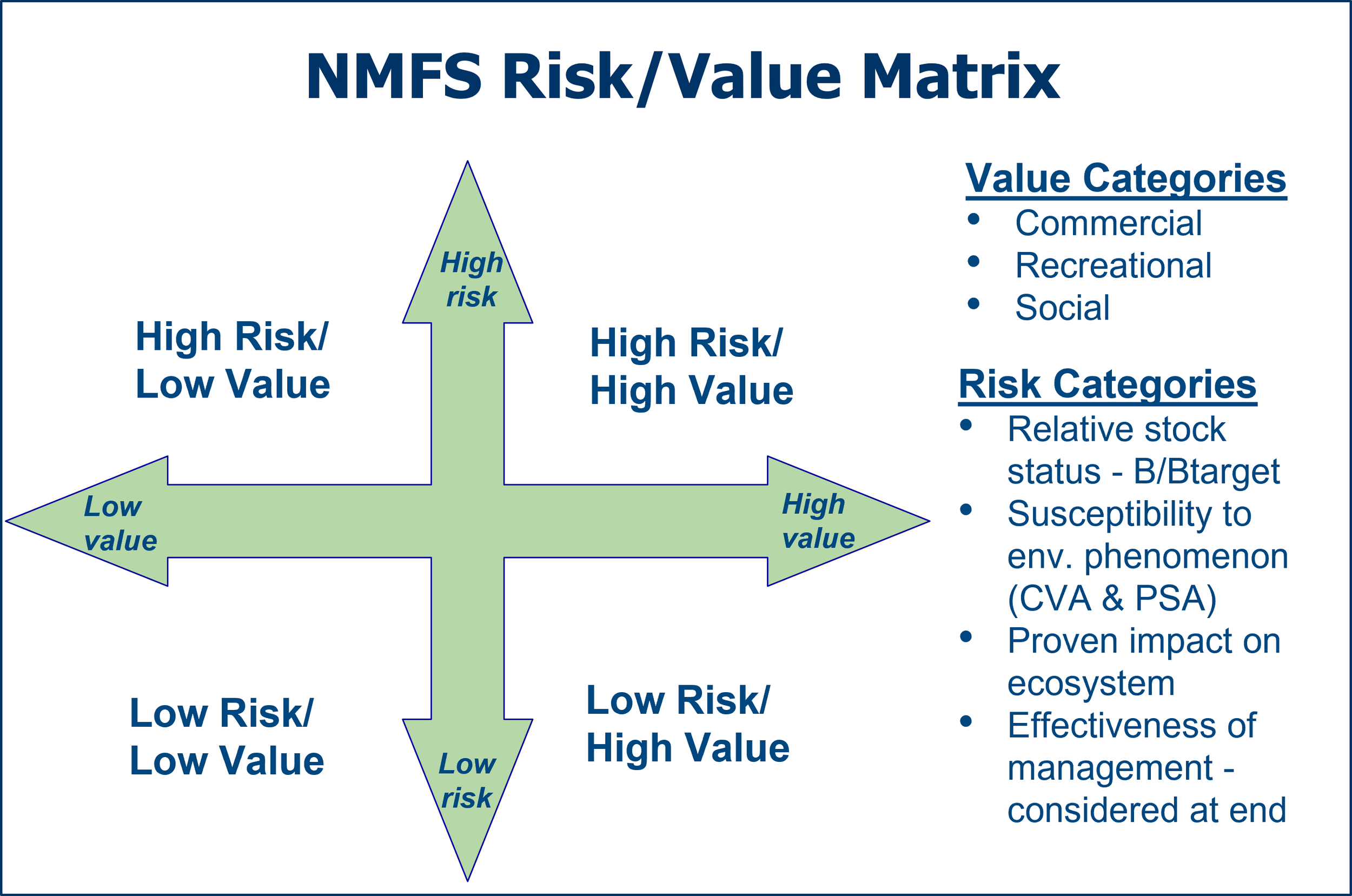
NOAA Fisheries has finalized a risk/value matrix and supporting methodology intended to help prioritize fisheries management and science activities nationwide. A baseline assumption guiding this effort is that NOAA Fisheries cannot continue to manage the 500+ stocks and stock complexes currently included in federal fishery management plans.
Under the proposed framework, stocks would be evaluated based on measures of “value” (e.g., commercial, recreational, or social importance) and “risk” (e.g., relative stock status, environmental vulnerability, ecosystem role, effectiveness of management) to inform potential reprioritization of science and management resources.
Each Council has been asked to work with their Regional Office and Science Center to co-develop a regional matrix by June 30 and to identify any potential management adjustments that may be needed. On February 2, the regional fishery management councils sent a joint letter to NOAA Fisheries expressing concerns about the proposed methodology and requesting several clarifications.
Public Comments on Executive Order 14276
The Council received a summary of public comments received by NOAA Fisheries on Executive Order 14276: Restoring American Seafood Competitiveness. The agency solicited public input from August 27 to October 14, 2025, and subsequently reopened the comment period from December 1-15, 2025. After reviewing the comments, the Council did not identify any issues that warranted revisions to the recommendations and work plan it submitted to NOAA Fisheries in September 2025.
Next Council Meeting
The next Council meeting will be held April 7-9, 2026 in New York, NY. A complete list of upcoming meetings can be found at https://www.mafmc.org/council-events.