Proposals Due December 4, 2026
Announcing the 2027 Marine Resource Education Program Greater Atlantic Workshop
The next Greater Atlantic Fisheries Science & Management Workshop will be held January 11-15, 2027, in Falmouth, MA. Apply by November 6!
2026 Mid-Atlantic Fisheries Photo Contest Winners
NOAA Fisheries Publishes Updated Historical Recreational Fishing Estimates
August 31, 2026 - The following was released by NOAA Fisheries:
NOAA Fisheries has published updated recreational fishing effort and catch estimates for hundreds of species dating back to 1981, reflecting the improved Fishing Effort Survey (FES) design.
Bottom Line: This data revision does not trigger immediate fisheries management changes or adjustments to catch limits. NOAA Fisheries and regional partners will begin integrating the improved data into prioritized stock assessments to help determine the health of stocks and provide new management advice, if warranted, through standard public processes.
The revised estimates will be used in stock assessments in late 2026 going forward. Of note, an assessment for South Atlantic red snapper is scheduled in late 2026, and assessments for striped bass and Gulf of America vermillion snapper are scheduled in 2027. Management advice from these assessments will be made in 2027 and 2028. For more information on regional fishery assessment schedules, visit the Northeast Region Coordinating Council schedule; Atlantic States Marine Fisheries Commission schedule; Southeast Data Assessment, and Review schedule and the West Pacific Stock Assessment and Review schedule for the full list of species and timelines.
Key takeaways:
The historical trends in recreational fishing activity remain largely the same, but the updated historical total catch estimates are systematically lower with smaller margins of error. This is because the improved FES design addresses overreporting of private boat and shore fishing trips and produces lower effort estimates.
The magnitude of the reduction in total catch estimates varies by species since the updated effort estimates differ by state, fishing mode (shore vs. private boat), and time of year.
Reductions are most pronounced for fisheries occurring in low-activity months via private boat.
Data outliers across the time series are reduced.
Note: The FES effort estimates are multiplied by the catch-per-trip estimates from in-person dockside interviews to calculate total catch. For-hire effort estimates come from the For-Hire Survey, not FES, and are unaffected by this revision. Highly Migratory Species estimates in the Northeast region are derived primarily from the Large Pelagics Survey. This revision does update information for Southeast HMS species as well as Atlantic and Gulf of America coastal shark species.
Why we made this change: Implementing the updated FES in 2026 and revising the historical estimates is a result of listening to partner and industry feedback, conducting thorough research, and aiming to continuously improve our survey methods and data. An independent peer review panel found the revised FES to be a substantial improvement that produces more accurate data by mitigating overreporting of fishing trips. The calibration model used to rescale the historical estimates was also favorably independently peer reviewed. More detail on the improved FES and calibration model is available here. Each improvement we make to our survey program helps strengthen our scientific understanding of the health of our fisheries, aligning directly with the Gold Standard Science Executive Order (EO) in ensuring our federal decision-making is rooted in the most rigorous and objective science available.
Improving the FES and resulting data also supports the Recreational Angler Partnership Improvement Directive (RAPID), which aims to build a new, modernized state-federal recreational fisheries data collection enterprise. This enterprise will combine all available and approved recreational catch and effort data collection programs to help reduce uncertainty in fishery management decisions. RAPID aims to increase data precision, accuracy, usability, and credibility for all surveys across the partnership.
NOAA Fisheries: Expertise Needed from Scup Fishermen
If you’ve been seeing or catching scup, NOAA Fisheries would love to hear from you. Staff are working to better understand both scup behavior and the practices of the people who know the fishery best—the fishermen, watermen, and anglers out on the water.
Your knowledge can help improve the scup stock assessment process, provide insight into fishing practices and local changes, and support better fishery management. It only takes about five minutes to share your perspective through a short survey, and your input can make a difference.
Find more information here.
August 2026 Council Meeting Summary
The Mid-Atlantic Fishery Management Council met August 11-13, 2026 in Philadelphia, PA. This document summarizes key actions taken and issues considered during the meeting. Presentations, briefing materials, motions, and webinar recordings are available on the Council’s August 2026 meeting page.
During this meeting, the Council:
Adopted 2027-2028 specifications for Atlantic surfclam and ocean quahog
Reviewed and recommended no changes to previously adopted 2027 specifications and commercial measures for summer flounder, scup, and black sea bass
Reviewed and recommended no changes to previously adopted 2027 specifications and recreational measures for bluefish
Approved modifications to the commercial scup Winter I trip limit requirements and landings-based accountability measures through the Commercial Scup Winter I Framework
Adopted 2027-2029 specifications for butterfish
Reviewed and recommended no changes to previously adopted 2027 specifications for chub mackerel
Reviewed input from listening sessions on potential monkfish/skate fishery improvements
Received informational presentations on the Marine Resource Education Program and federal fishery-independent surveys conducted by the Northeast Fisheries Science Center
Re-elected Joe Cimino as Council Chair and Skip Feller as Council Vice Chair
Check out the full summary linked below for complete details.
Northeast Region Coordinating Council Seeks Peer Reviewers for Future Management Track Stock Assessments
The Northeast Region Coordinating Council (NRCC) is seeking applications from qualified independent subject-matter experts to serve as peer reviewers for fishery stock assessments in the Greater Atlantic region including New England and Mid-Atlantic offshore waters.
APPLICATION DEADLINE: Applications will be accepted on a rolling basis and maintained by the NRCC.
PURPOSE: Peer reviews are a critical component of the stock assessment process, ensuring the highest standards of scientific rigor and integrity. Peer reviewers prep for and attend multi-day meetings in Woods Hole, MA, typically in June and September. The work also includes co-authoring a Peer Review Panel report.
TO APPLY: Please view the Call for Applications. A curriculum vitae, cover letter, and references can be sent to cokeefe@nefmc.org or mailed to:
Dr. Cate O’Keefe
New England Fishery Management Council
50 Water Street, Mill 2
Newburyport, MA 01950
For more information, please refer to the NRCC’s Description of Stock Assessment Process and NEFSC’s Management Track Stock Assessments website, which includes the Management Track Generic Terms of Reference. If you have questions or need further information, please contact Cate O’Keefe: cokeefe@nefmc.org.
Request for Proposals: Photography Services
NOAA Fisheries Seeks Comments on Ropeless Fishing
June 2026 Council Meeting Summary
The Mid-Atlantic Fishery Management Council met June 16-18, 2026 in Alexandria, VA. The following is a summary of actions taken and issues considered during the meeting. Presentations, briefing materials, motions, and webinar recordings are available on the Council’s June 2026 meeting page. Download a PDF version of this meeting report here.
Highlights
During this meeting, the Council:
Reviewed and provided feedback on a draft range of alternatives for the Scup Winter I Framework
Adopted 2027-2029 specifications for blueline tilefish
Reviewed previously adopted 2027 specifications for golden tilefish and recommended no changes
Received an update on the joint Mid-Atlantic and New England Councils’ evaluation of vessel baseline restrictions
Reviewed the 2026 Mid-Atlantic State of the Ecosystem Report and the EAFM risk assessment summary report
Reviewed an annual report on commercial landings of unmanaged species
Received a presentation on upcoming Atlantic mackerel cooperative research
Received updates on a variety of topics from the Northeast Fisheries Science Center’s Fishery Monitoring and Research Division
Scup Winter I Framework
The Council reviewed a draft range of alternatives for the Commercial Scup Winter I Framework. This action considers options to provide additional management flexibility to the NOAA Fisheries Greater Atlantic Regional Fisheries Office (GARFO) during the Winter I quota period, and to preserve harvest opportunities across all three quota periods (Winter I, Summer, and Winter II) when practicable.
Currently, the Winter I possession limit is reduced from 50,000 pounds to 1,000 pounds once 80 percent of the Winter I quota is landed. This system was designed to distribute landings more evenly across the period and prevent quota overages. An analysis presented at the April 2026 Council meeting highlighted how certain factors prevented timely implementation of the trip limit reduction in recent years (2023-2026), and 2026 experienced an unprecedented overage of the Winter I quota. Under current Accountability Measures (AMs), this overage must be deducted from the 2027 Winter I quota.
The range of alternatives presented to the Council included options that would modify 1) Winter I trip limit requirements, 2) catch reporting requirements for limited access scup permits and/or dealers, and 3) landings-based AMs for the commercial scup fishery. To streamline the framework for expedient implementation, the Council agreed to remove two reporting alternatives from further consideration. Alternative 2D, which would require federally permitted commercial vessels to report scup catch through the Interactive Voice Response (IVR) system, was removed because it would be duplicative with Alternative 2C, which would require reporting through the Vessel Monitoring System. The Council also removed Alternative 2B, which would require vessels and/or dealers to report scup catch on a shortened timeline, noting that other alternatives under consideration would provide the tools and information needed to avoid future Winter I quota overages.
The Council also requested that staff add language to the framework document emphasizing that the combined use of alternatives 1B and 1C would provide the Regional Administrator with the greatest level of flexibility to manage the Winter I quota.
The modified range of alternatives will be further developed, with final action tentatively scheduled for August 2026. Updates on this action can be found here.
2027-2029 Blueline Tilefish Specifications
The Council reviewed the stock status and performance of the blueline tilefish fishery and adopted multi-year specifications (catch and landings limits) for 2027-2029, as summarized in the table below.
Blueline tilefish are considered a single stock along the U.S. Atlantic Coast, and the assessment is conducted through the Southeast Data and Assessment Review (SEDAR) process; however, due to limited data for the portion of the stock north of Cape Hatteras, NC, the assessment evaluates areas north and south of Cape Hatteras separately. The stock was last assessed in 2025 (SEDAR 92) using the data limited methods (DLM) toolkit. The Council’s Scientific and Statistical Committee (SSC) concluded that new information was insufficient to alter the previous Acceptable Biological Catch (ABC) and therefore recommended maintaining the ABC at 205 metric tons for 2027-2029. The Council endorsed this recommendation and agreed to maintain the previously approved catch and landing limits with the updated estimates of dead discards for 2027-2029. The Council recommended no changes to commercial or recreational management measures.
During the discussion, the Council noted several sources of uncertainty, including the lack of stock status information and the high uncertainty in private recreational catch estimates. The Council agreed to write a letter to NOAA’s Highly Migratory Species (HMS) requesting they add a short description related to the private recreational tilefish permit and reporting on their HMS permit webpage, given the high overlap between the two fisheries.
| Summary of Blueline Tilefish 2027-2029 Specifications | |
|---|---|
| Acceptable Biological Catch | 452,200 pounds |
| Recreational Total Allowable Landings | 313,601 pounds |
| Recreational Trip Limits |
Private vessel: 3 fish USCG uninspected for-hire vessel: 5 fish USCG inspected for-hire vessel: 7 fish |
| Commercial Total Allowable Landings | 109,885 pounds |
| Commercial Trip Limits | 500 pounds (reduced to 300 pounds once 70% of the quota has been landed) |
2027 Golden Tilefish Specifications
In 2027, golden tilefish will be in year 3 of multiyear specifications previously adopted for the 2025-2027 fishing years. After reviewing updated fishery information and considering recommendations from its SSC, Tilefish Monitoring Committee, Advisory Panel, and staff, the Council recommended no changes to the 2027 specifications. Additional details about these specifications are provided in the August 2024 Meeting Summary.
Vessel Baseline Evaluation
The Council received an update on the joint Mid-Atlantic and New England Council evaluation of vessel baseline restrictions, including a summary of permit data and input received during three recent Advisory Panel meetings and an associated comment period. Council members shared differing opinions on the costs and benefits of vessel baseline restrictions and discussed how considerations vary by fishery and gear type.
Current regulations require that, for most limited access fisheries managed by the Mid-Atlantic and New England Fishery Management Councils, a vessel or engine replacement or upgrade cannot exceed 10% of the length and 20% of the horsepower of the permit's baseline specifications. The evaluation is intended to inform whether the Councils should consider initiating a management action to revise these restrictions.
The evaluation is expected to be completed in time for the October Council meeting, when the Council will discuss its draft priorities for 2027.
2026 Mid-Atlantic State of the Ecosystem Report
Dr. Abby Tyrell, Northeast Fisheries Science Center (NEFSC), presented key findings from the 2026 Mid-Atlantic State of the Ecosystem (SOE) report. This report gives information on the status and trends of relevant ecological, environmental, economic, and social components of the Mid-Atlantic Bight ecosystem. The report evaluates the performance of different ecosystem indicators relative to management objectives and the potential climate and ecosystem risks to meeting management objectives. For the first time, the 2026 report included seasonal bottom temperature forecasts that are predicting normal to below average temperatures throughout most of the Northeast shelf in 2026. Other highlights from the 2026 report include:
Globally, 2025 was the third warmest year on record but the seasonal surface and bottom temperatures for the Northeast shelf were similar to or cooler than the long-term average.
The Cold Pool, an important oceanographic feature in the Mid-Atlantic for fish spawning and nursery habitat, had been getting warmer and shrinking but saw a return to near normal conditions in 2025.
Commercial landings in 2024 were at a historic low and total commercial revenue continues to decline and near an all-time low.
Recreational landings continued to decline in 2024, while recreational effort was near average.
There are long-term changes in zooplankton biomass and composition, fish community composition, and reduced fish productivity for many managed stocks suggests a potential change in the ecosystem to faster growing and lower trophic level species.
The NEFSC continues to look for fishing industry input to help inform future SOE reports. Fishing community observations on unusual events, including high/low abundance or differences from recent conditions, are encouraged and can be provided at northeast.ecosystem.highlights@noaa.gov.
Ecosystem Approach to Fisheries Management (EAFM) Risk Assessment Report
The Council reviewed the 2026 EAFM risk assessment summary report. The risk assessment is updated annually and is a tool that allows the Council to look across all species and sectors to identify high risk interactions in which to prioritize for further consideration and evaluation. The 2026 risk assessment utilizes the most recent information, new analyses, and updated indicators to inform the level of risk for 28 risk elements across ecological, socioeconomic, and management factors. Nearly 79% of all risk elements are low or low-moderate risk, an increase by over 6% from 2025 indicating lower risk, in general, across all Council managed stocks relative to the previous year. Both the State of the Ecosystem and risk assessment reports indicate that conditions and risk at the species/stock level are generally positive, but when looking at broader ecosystem both reports show declining trends and higher risk and there may be some underlying dynamics at play that may be worth investigating.
Unmanaged Commercial Landings Report
The Council reviewed an annual report that summarizes commercial landings of species in locations where they are not managed at the state or federal level with a possession limit, size limit, seasonal closure, or limited access. The report also summarizes commercial landings of the species designated as Ecosystem Components through the Council’s Unmanaged Forage Omnibus Amendment. The goal of this report is to look for signs of developing commercial fisheries. This year’s report included new data visualizations and statistical analyses. Unmanaged commercial landings have been generally declining in recent years; however, a few species had statistically significant increases in landings in the most recent 5 years (2021-2025) compared to the prior 15 years (2006-2020), including Atlantic cutlassfish, ribbonfish, silversides, and mantis shrimps. The Council did not express any concerns with the landings trends shown in this year’s report.
NEFSC Atlantic Mackerel Cooperative Research Initiative (“MackPack”)
Dr. Anna Mercer, NEFSC Cooperative Research Branch Chief, provided an overview of upcoming Atlantic mackerel cooperative research to be conducted in 2026, 2027, and 2028. The results of the research are expected to inform future mackerel assessments, possibly in 2029 (results would likely not be available soon enough to inform the scheduled 2027 assessment). Key research elements include acoustic detection, egg survey uncertainty/spawning timing refinements, U.S. - Canada movement/mixing, and ecosystem drivers. Industry collaboration will occur across all elements. For more information, contact Dr. Mercer at anna.mercer@noaa.gov.
NEFSC Fisheries Monitoring and Research Division (FMRD) Programs
KB McArdle, NEFSC Fishery Monitoring Research Division Director, provided an update on the NEFSC Fishery Monitoring and Research Division, including FMRD’s role in collecting commercial fishery information for use in fisheries science and management. The presentation covered the Standardized Bycatch Reporting Methodology, 2025 NEFOP and Industry-Funded Scallop coverage accomplishments, biological port sampling, and the NEFOP/NEPBSP contract merge. Key updates included the upcoming 2026 SBRM 3-year review, observer coverage accomplishments, spiny dogfish sampling changes, expanded biological port sampling coordination, and future efforts to improve sampling efficiency and flexibility. For more information, contact KB at Katherine.McArdle@noaa.gov.
Departing Council members Sonny Gwin and Michelle Duval
Other Business
Departing Council Members
The Council bid farewell to two Mid-Atlantic Council members, Sonny Gwin (Maryland) and Michelle Duval (Pennsylvania). Mr. Gwin completed nine years of service on the Council after his appointment in 2017. He chaired the Spiny Dogfish Committee for the past six years, helping guide discussions on dogfish specifications and the development of revised accountability measures intended to provide greater stability for the fishery. He also served as the Council’s liaison to the South Atlantic Fishery Management Council for three years. Dr. Duval completed six years of service on the Council after being appointed in 2020. During her tenure, she chaired both the Research Steering Committee and the Ecosystem and Ocean Planning Committee, helping advance several important ecosystem initiatives, including reviews of ecosystem risk assessment processes, exempted fishing permit policies, and the Essential Fish Habitat review process. The Council thanked both members for their years of dedicated service to the Council.
U.S. Fish and Wildlife Service “Shellfish” Definition
Dr. Jenifer Chatfield, Deputy Assistant Secretary for Fish and Wildlife and Parks, announced that the U.S. Fish and Wildlife Service would soon be publishing a final rule to amend the definition of “shellfish” in the Code of Federal Regulations by removing the phrase “having a shell” and adding specific taxa. This change would clarify that squid and other cephalopods are included within the regulatory definition of shellfish. This change brings the definition in line with current biological understanding and addresses a long-standing concern of the Mid-Atlantic Council and the U.S. squid industry.
Next Council Meeting
The next Council meeting will be held August 11-13, 2026, in Philadelphia, PA. A complete list of upcoming meetings can be found at https://www.mafmc.org/council-events.
Request for Nominations: Scientific and Statistical Committee
U.S. Fish and Wildlife Service Finalizes Rule Clarifying Squid as “Shellfish”
The Mid-Atlantic Fishery Management Council welcomed a final rule published today by the U.S. Fish and Wildlife Service (USFWS) which clarifies that squid and other cephalopods are included within the regulatory definition of “shellfish.” This change brings the definition in line with current biological understanding and addresses a long-standing concern of the Mid-Atlantic Fishery Management Council and the U.S. squid industry.
Previously, squid were not recognized by USFWS as “shellfish” or “fishery products” and therefore did not qualify for an exemption from certain import and export rules intended to prevent the unauthorized trade of endangered and protected wildlife. While virtually all other U.S. commercial fishery products qualified for the exemption, the U.S. squid industry remained subject to additional licensing, inspection, and user fees that industry members described as duplicative and costly.
The Council has long maintained that these requirements placed U.S. squid producers at a competitive disadvantage in international markets. The issue was identified as a top priority in the Council’s responses to both Executive Order 13921 on Promoting American Seafood Competitiveness and Economic Growth (2020) and Executive Order 14276 on Restoring American Seafood Competitiveness (2025). The Council has detailed the economic impacts of the previous definition in multiple communications to leadership at the Department of the Interior, USFWS, and NOAA Fisheries, including a comprehensive request for action sent to the Secretary of Interior in December 2020.
“We are pleased to see this final rule published,” said Council Executive Director Chris Moore. “This is a common-sense change that will reduce unnecessary regulatory burdens on the U.S. squid industry while improving consistency and clarity in federal regulations. We appreciate the U.S. Fish and Wildlife Service's responsiveness to stakeholder concerns, as well as the support from our partners at NOAA Fisheries in helping to achieve this outcome.”
The Mid-Atlantic Council manages Atlantic longfin squid and Illex squid fisheries in federal waters off the U.S. East Coast as part of its Mackerel, Squid, and Butterfish Fishery Management Plan. For additional background information related to this issue, visit the Council’s website.
Important Regulatory Update: Changes to Summer Flounder Commercial Minimum Mesh Size Flynet Exemption
MAFMC and ASMFC Seek Participants for Recreational Sector Separation Workshop
50 Years of Regional Fisheries Management Sustaining Fisheries and Fishing Communities Since 1976
The nation’s eight Regional Fishery Management Councils commemorated the 50th anniversary of the Council system this week during the Council Coordination Committee meeting in Homer, Alaska. The Council system was established by Congress through the Magnuson-Stevens Fishery Conservation and Management Act signed on April 13, 1976. For five decades, the Councils have played a central role in conserving marine resources while supporting fishing communities and a vibrant U.S. seafood economy.
Since their creation, the Councils have promoted sustainable management of U.S Fisheries, in partnership with NOAA Fisheries, states, tribes, and communities. The Councils have rebuilt fish stocks, reduced bycatch, and protected essential fish habitat all while supporting sustained harvest with the goal of maximizing benefits to fishing communities and consumers. The Councils are proud to celebrate 50 years dedicated to:
Supporting Economies and Coastal Communities: Commercial, recreational, and subsistence fisheries are vital to coastal communities and the nation’s economy. U.S. fisheries support millions of jobs, generate billions of dollars in economic activity, and provide seafood to domestic and global markets. Recreational fishing contributes to tourism and outdoor leisure, while subsistence fisheries remain critical to food security and cultural traditions in many regions. Fisheries are more than an industry—they are a way of life deeply tied to the identity of coastal communities nationwide.
A Transparent, Stakeholder-Driven System: The Council system is built on open and inclusive governance. Councils consist of members from each regional maritime state or territory, and represent the commercial and recreational fishing industry, scientists, managers, tribal and Indigenous representatives. Through meetings, advisory bodies, and a robust system for incorporating public comment, community members help shape fishery management measures. This transparent process ensures decisions are grounded in the best available science and informed by on-the-water experience.
Regionally Tailored, Adaptive Management: By design, the Councils provide flexibility to address the unique fisheries, ecosystems, and challenges of each region. From Alaska to the Caribbean, Councils develop management strategies tailored to regional conditions while meeting national conservation standards. The system continues to evolve through adaptive and innovative approaches that respond to changing environmental, economic, and social conditions.
As the Councils look towards the future, they remain committed to sustaining productive fisheries and healthy marine ecosystems for generations to come. Continued investment in collaborative management is essential to supporting the fisheries, communities, and economies that depend on them.
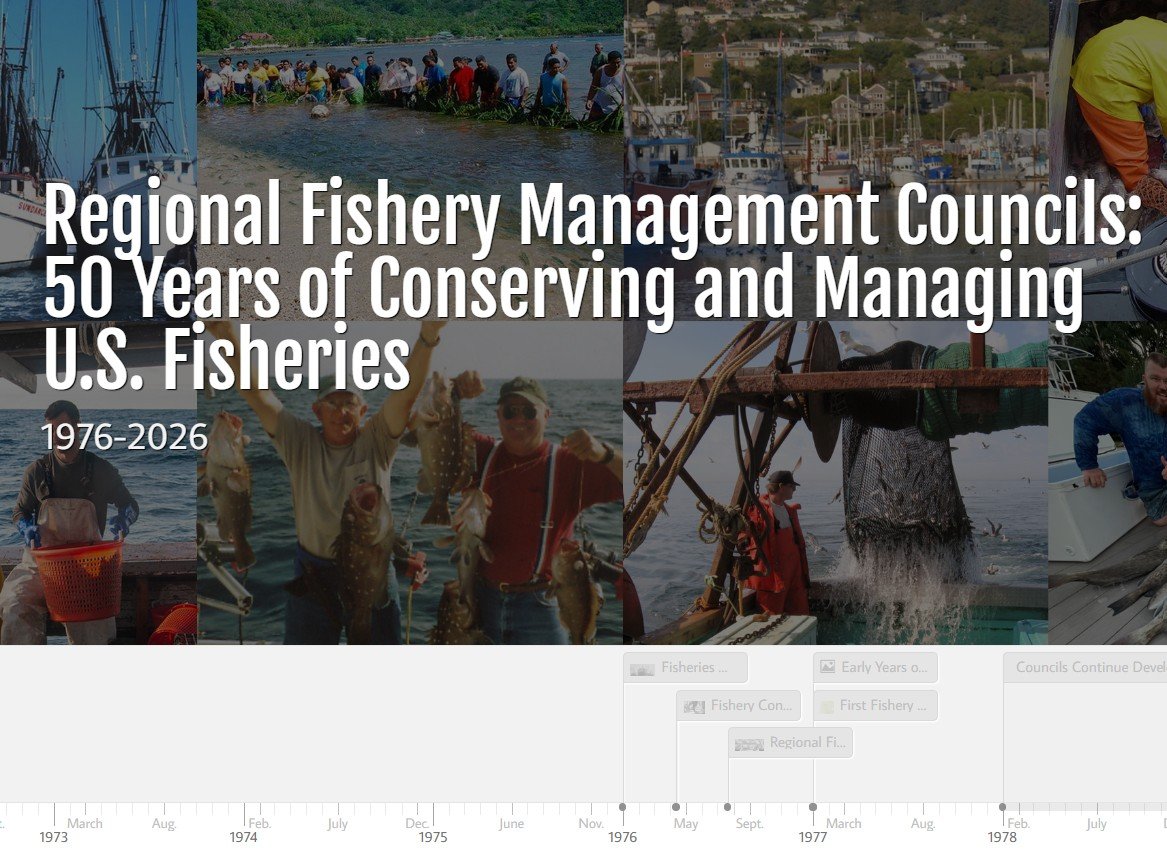
To mark the anniversary, the Councils developed an interactive timeline highlighting major milestones in U.S. fisheries management over the past five decades. Check out the timeline and learn more about the Councils at https://www.fisherycouncils.org/50th-anniversary.
NOAA Fisheries Approves Conservation Equivalency for the Summer Flounder and Black Sea Bass Recreational Fisheries, as well as Coastwide Measures for the Scup Recreational Fishery, for 2026 and 2027
NOAA Fisheries implemented the Recreational Measures Setting (RMS) Process Framework to the Summer Flounder, Scup, and Black Sea Bass and Bluefish Fishery Management Plans on April 28, 2026. The framework implements the process used to set recreational management measures (bag, size, and season limits) for summer flounder, scup, black sea bass, and bluefish, as recommended by the Mid-Atlantic Fishery Management Council and the Atlantic States Marine Fisheries Commission. The changes also include modifications to the recreational accountability measures for all four species. Details on how the RMS Process works are available in the interim final rule.
In addition, NOAA Fisheries is announcing the 2026 and 2027 summer flounder, scup, and black sea bass recreational fishery management measures. This rule filed with the Federal Register today, and is expected to publish and be effective on April 30, 2026.
Management measures for 2026 and beyond could not be finalized until the RMS Process Framework was approved and effective. The RMS Process aims to provide continued stability and predictability in recreational measures from year to year while accounting for uncertainty in recreational catch estimates.
For 2026 and 2027, we are implementing the following recreational management measures:
Scup: Maintaining the status quo coastwide measures for recreational fishing in Federal waters and by federally permitted for-hire vessels;
Summer Flounder: Federal coastwide measures are waived through the continued use of conservation equivalency, allowing for status quo levels of harvest managed through state or regional measures; and
Black Sea Bass: Federal measures are waived through the continued use of conservation equivalency for black sea bass, allowing for a 20-percent increase in harvest collectively through state or regional measures.
As in prior years, we are approving the use of conservation equivalency for the summer flounder and black sea bass recreational fisheries. Under conservation equivalency, Federal coastwide measures are waived in favor of state- or region-developed measures. The states or regions have developed minimum sizes, possession limits, and fishing seasons that, in combination across all participating states, will achieve the necessary level of conservation.
Individuals seeking information regarding the measures for individual states should contact the marine fisheries agency in the state of interest.
Read the interim final rule for the RMS Process Framework as published in the Federal Register. We will be accepting public comment on this interim final rule through May 28.
Read the interim final rule for 2026 and 2027 Recreational Management Measures. These regulations are effective when the rule is published on April 30, and is available for public inspection today, April 29. The public comment portal opens upon publication and comments will be accepted through May 15.
For more information, please see the Fisheries Bulletin.
NOAA Fisheries Implements Framework 18 to the Summer Flounder, Scup, and Black Sea Bass Fishery Management Plan
NOAA Fisheries Implements and Seeks Comments on Framework Adjustment 17 to the Mackerel, Squid, and Butterfish Fishery Management Plan
Council Presents Ricks E Savage Award to Peter Hughes
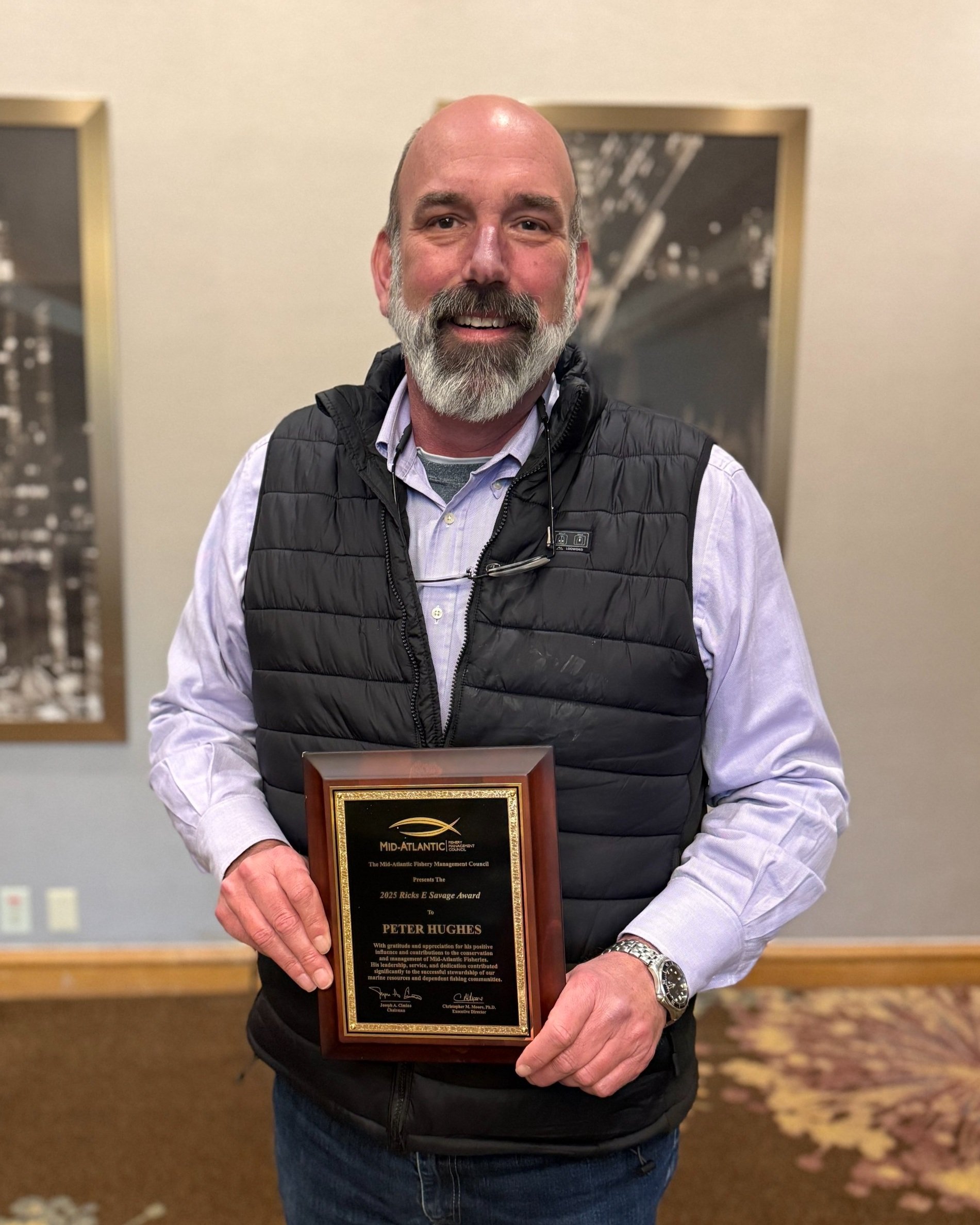
Award Recipient Peter Hughes
The Mid-Atlantic Fishery Management Council has named Peter Hughes, longtime industry representative and former Council member, as the recipient of the 2025 Ricks E Savage Award. The Council established the award in 2006 to recognize individuals who have made significant contributions to the management and conservation of fishery resources in the mid-Atlantic region. The award was presented to Hughes during the Council's meeting last week in New York City.
A native of Elyria, Ohio, Hughes first discovered his love of fishing during family vacations on Long Beach Island. That early passion eventually led him to Cape May, New Jersey, in 1986, where he began his career in commercial fisheries aboard the F/V Atlantic Prince. In 1990, he transitioned to a shoreside role at Atlantic Capes Fisheries, Inc., where he has worked for more than 35 years and now serves as Director of Sustainability. Hughes was appointed to the Council in 2016 and served with distinction for nine years before completing his service in 2025. During this time, he became one of the Council’s most steadfast leaders, bringing broad, practical knowledge of fisheries to every discussion.
As Chair of the Council’s Mackerel, Squid, and Butterfish Committee for eight years, Hughes guided the Council through the development of several challenging management actions, including two Atlantic mackerel rebuilding actions, an amendment to establish long-term management of chub mackerel, and a framework that established measures to limit future capacity increases in the Illex squid fishery. He also served as Chair of the Surfclam and Ocean Quahog Committee for five years, providing steady leadership throughout the development of a major amendment to modify species separation requirements in the Atlantic surfclam and ocean quahog fisheries.
Hughes also served as the Council's liaison to the New England Fishery Management Council throughout his entire tenure, representing the Mid-Atlantic Council on several New England committees. In that role, he ensured clear communication between the Mid-Atlantic and New England Councils, conveying priorities, decisions, and concerns in both directions.
Hughes was also recognized for his approach to public engagement. “Peter took public comment very seriously and was sensitive to the competing interests of recreational and commercial stakeholders, as well as differing sectors within the industry,” said Joe Cimino, Council Chair. “He always came to the table with the goal of finding the best possible solutions for all parties.” One notable example came during the development of the Atlantic Mackerel Rebuilding Amendment, when the Council was considering a federal recreational possession limit for mackerel. Early options ranged from 10 to 15 fish. After reviewing public comments and input from the New England states regarding the potential impacts on for-hire businesses that rely on mackerel for bait, Hughes proposed expanding the range to include a 20-fish limit. The Council ultimately adopted that option, which reduced the burden on those businesses while still meeting rebuilding objectives.
The Council extends its gratitude to Peter Hughes for his years of dedicated service and congratulates him on this well-deserved honor.
New England Council to Hold Monkfish and Skate Listening Sessions
The New England Fishery Management Council (Council) will hold five listening sessions to solicit comments on ideas for fishery improvements in the monkfish and skate fisheries. These sessions are designed to identify the challenges the monkfish and skate fishing sectors are grappling with and to identify possible management measures for the Council to address those challenges in the future. Additional details, including the listening session schedule and instructions for submitting written comments, can be found at the link below.